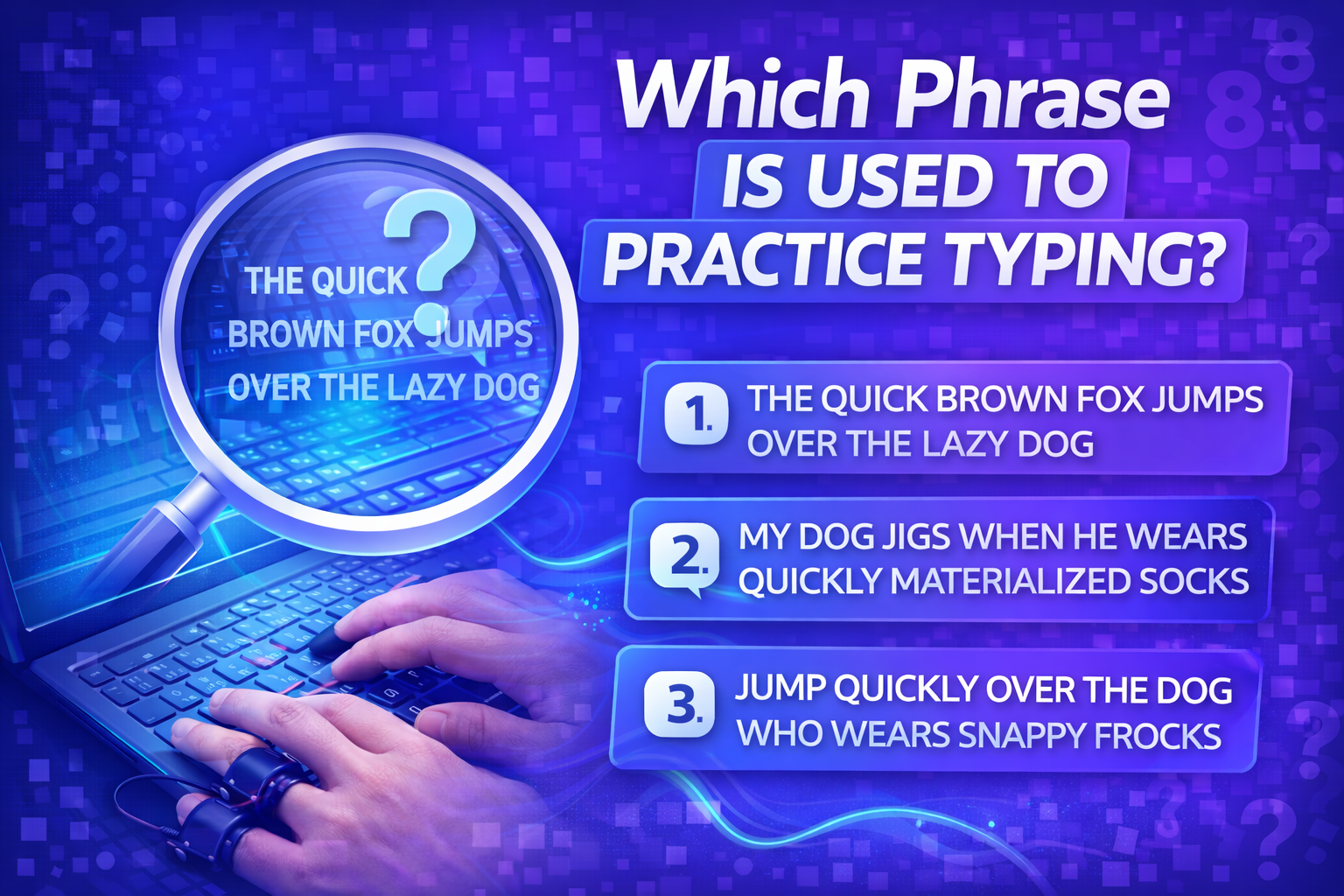
If you have ever taken a typing class or tested a keyboard, you have likely wondered which phrase is used to practice typing and why it appears everywhere. The answer is not random, and it is not chosen for humor alone.
It is a carefully structured sentence that contains every letter of the alphabet, helping you train all fingers evenly and improve accuracy. When you understand how and why this phrase works, you can use it strategically to increase your typing speed, sharpen muscle memory, and measure real progress.
What Is the Phrase Which Is Used to Practice Typing?
The phrase that is used to practice typing most often is “The quick brown fox jumps over the lazy dog.” This sentence is a pangram, meaning it includes every letter of the alphabet at least once. Because it covers all 26 letters, it forces you to move across the entire keyboard rather than repeating common letters.
Typing instructors in the United States have relied on this sentence for decades because it trains both hands evenly. You engage your left hand with letters like Q, W, E, and R while also activating your right hand with letters such as J, K, L, and O. This balanced finger movement builds coordination and supports long-term typing improvement.
Why Pangrams Improve Typing Performance
Pangrams challenge you to use rarely typed letters like Q, Z, X, and J in a natural sentence structure. In everyday English, letters such as E and T appear far more frequently than Z or Q, which can leave weak spots in your technique. A pangram corrects that imbalance by forcing you to practice every key in a single line.
Research into typing performance shows that structured repetition improves motor learning and muscle memory. When you type a pangram consistently, your brain forms stronger neural pathways connected to each keystroke. Over time, this leads to faster response times and fewer mistakes.
The History Behind “The Quick Brown Fox”
The sentence “The quick brown fox jumps over the lazy dog” dates back to the late nineteenth century. It appeared in American newspapers and quickly became a favorite example in typing books and printing tests. Early typewriter manufacturers used it to demonstrate that every key worked properly.
Printers and designers also relied on it to display complete font samples. When you see this sentence in a font preview, you instantly know how each letter looks. That practical value explains why it remains the dominant phrase that is used to practice typing today.
How This Phrase Trains Every Finger
When you type this pangram correctly, each finger has a specific role based on the standard touch-typing technique. Your pinky handles letters like Q and P, while your index fingers manage high-frequency letters such as F, J, and R. The phrase requires full keyboard coverage, which strengthens weak fingers over time.
If you are unsure whether your speed meets common standards, reading benchmarks such as what is the average typing speed can help you compare your results with national norms. Most adults type between 40 and 50 words per minute, while professional typists often exceed 70 WPM. Practicing pangrams consistently can push you toward those higher ranges.
Measuring Progress With Structured Testing
Practicing a pangram is useful, but measuring improvement requires structured evaluation. You need a controlled test environment that tracks words per minute, accuracy percentage, and error rate. Without measurable feedback, it becomes difficult to identify weaknesses.
Using the online Words Per Minute Test allows you to track real-time typing metrics in a standardized format. The platform calculates your WPM and highlights errors, giving you objective data rather than guesswork. That data-driven approach helps you strategically adjust your practice sessions.
Alternative Phrases Used to Practice Typing
Although the quick brown fox sentence is the most famous example, it is not the only option. Other pangrams, such as “Pack my box with five dozen liquor jugs” and “The five boxing wizards jump quickly,” also cover the alphabet. Rotating between phrases prevents memorization from artificially inflating your speed.
When you memorize a single sentence, you may type faster simply because you remember the pattern. Switching pangrams ensures that your improvement reflects real skill rather than repetition alone. This method creates a more accurate assessment of your typing ability.
Why Accuracy Matters More Than Speed
Many people focus on words per minute, but accuracy determines long-term performance. Typing at 80 WPM with frequent mistakes slows you down when corrections are required. Employers often prioritize precision because errors affect productivity.
If you are wondering about high-performance benchmarks, reviewing what is a high typing speed is provides clarity about professional expectations. In competitive environments, speeds above 75 WPM with high accuracy are considered strong. Consistent pangram practice can help you reach that level while maintaining control.
Using Pangrams for Warm Up Sessions
You can use the phrase to practice typing as a daily warm-up exercise. Begin each session by typing the sentence five to ten times at a moderate pace, focusing on clean keystrokes. Gradually increase speed only after achieving near-perfect accuracy.
This routine activates finger coordination and improves focus before longer typing tasks. Many experienced typists treat pangrams as a calibration tool, similar to stretching before exercise. The short investment of time delivers measurable performance improvements.
Common Mistakes When Practicing the Phrase
One common mistake is looking down at the keyboard while typing the sentence. Touch typing requires you to keep your eyes on the screen to build spatial memory. Glancing at keys interrupts that learning process.
Another mistake is prioritizing speed over form. If your wrists bend excessively or your posture collapses, you risk strain and long-term discomfort. Maintain neutral wrist alignment and consistent finger positioning for sustainable improvement.
How Often Should You Practice?
You do not need hours of repetition to benefit from pangram practice. Ten to fifteen minutes per day is sufficient for noticeable improvement within weeks. Consistency matters more than intensity.
According to typing education data, regular short sessions produce better retention than occasional long sessions. When you practice daily, muscle memory strengthens steadily. Over time, the phrase that is used to practice typing becomes a reliable tool for measurable growth.
Conclusion
Now you clearly understand which phrase is used to practice typing and why it remains essential in modern typing education. “The quick brown fox jumps over the lazy dog” works because it includes every letter, challenges weak keys, and trains balanced finger movement.
When you combine this pangram with structured testing, accuracy tracking, and consistent daily practice, you build a high-performance typing foundation that supports academic, professional, and personal success.
FAQs
Which phrase which is used to practice typing most commonly?
The phrase most commonly used to practice typing is “The quick brown fox jumps over the lazy dog.” It is a pangram containing all 26 letters of the English alphabet, which ensures you practice every key while improving speed, coordination, and overall keyboard familiarity.
Why is “The quick brown fox jumps over the lazy dog” effective for typing practice?
This sentence is effective because it forces you to use every letter from A to Z in a natural sequence. Engaging all fingers across the keyboard, it strengthens weaker keys, builds balanced muscle memory, and improves typing accuracy over time.
What is a pangram and how does it help with typing?
A pangram is a sentence that includes every letter of the alphabet at least once. Pangrams help with typing by requiring full keyboard coverage, preventing overuse of common letters, and training your hands to move efficiently across all rows and keys.
Are there other phrases which are used to practice typing?
Yes, other pangrams such as “Pack my box with five dozen liquor jugs” and “The five boxing wizards jump quickly” are also used. Rotating between different pangrams helps prevent memorization and encourages genuine skill development rather than pattern repetition.
How often should you practice typing with pangrams?
You should practice typing with pangrams for at least 10 to 15 minutes daily. Consistent short sessions improve muscle memory and coordination more effectively than occasional long sessions, helping you steadily increase your words per minute and maintain high accuracy.
Does typing the same phrase repeatedly really improve speed?
Yes, repeated practice of a pangram improves speed by reinforcing neural pathways linked to keystrokes. However, you should combine repetition with varied exercises to ensure that improvements reflect true typing skill rather than memorized sentence patterns.
Should you focus on speed or accuracy when practicing typing phrases?
You should prioritize accuracy before speed when practicing typing phrases. High accuracy builds proper finger positioning and reduces error correction time, which ultimately leads to faster and more reliable typing performance in academic, professional, and everyday tasks.
Can practicing pangrams help prepare you for a typing test?
Practicing pangrams can help prepare you for a typing test because they strengthen familiarity with uncommon letters and improve keyboard coverage. This preparation reduces hesitation during timed exams and increases both speed and confidence under testing conditions.
What is the average typing speed for adults in the United States?
The average typing speed for adults in the United States typically ranges from 40 to 50 words per minute. Professional typists often exceed 70 words per minute, especially when they maintain strong accuracy and consistent daily practice routines.
Is the quick brown fox sentence still relevant in modern typing practice?
Yes, the quick brown fox sentence remains relevant because it efficiently tests keyboards, displays fonts, and trains full alphabet coverage. Despite modern typing software, this classic pangram continues to provide a reliable foundation for skill development.